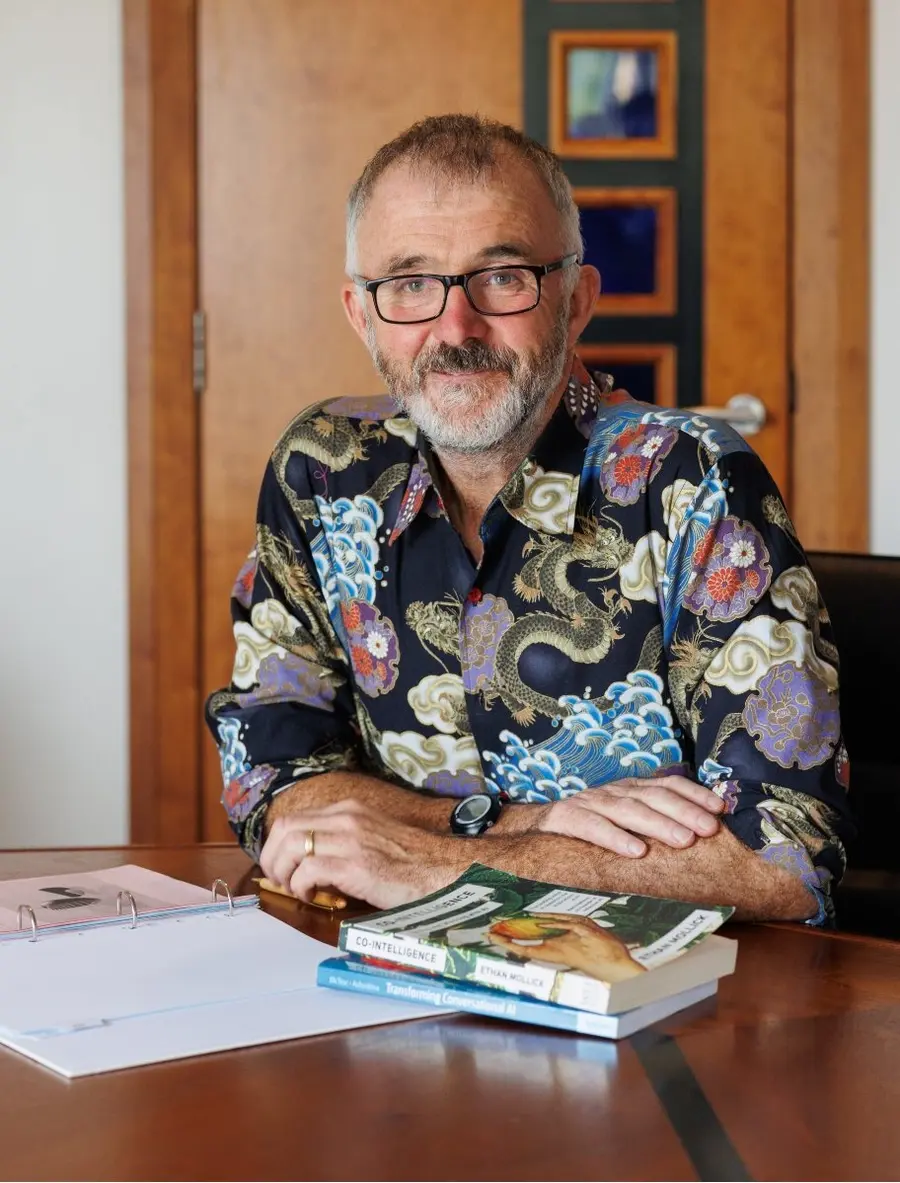


Barry Phillips (CEO) BEM founded Legal Island in 1998. He is a qualified barrister, trainer, coach, and meditator, and a regular speaker here in the UK and Ireland, and abroad.
Barry has completed the Oxford University course “Leading AI Implementation” in June 2026. He has trained hundreds of HR Professionals on how to use GenAI in the workplace and is the author of the book “ChatGPT in HR – A Practical Guide for Employers and HR Professionals”




This week Barry Phillips argues that latest stats suggest that AI is enhancing the role of employees rather than replacing them.
Transcript:
Hello Humans and welcome to the weekly podcast that aims to review an important AI development relevant to the world of HR in around five minutes.
For several years, the loudest conversation about artificial intelligence and employment has focused on one question:
Is AI coming for our jobs?
It is a fair question. But the latest evidence suggests that we may be asking the wrong one.The more immediate question for HR is this:
How do we help employees use AI to perform their jobs better, while managing the risks that come with it?Because employees are already adopting AI, whether their employers are ready or not.
Research published by Idealis Advisory in August 2026 found that 62 per cent of US workers now use generative AI professionally.
But only 40 per cent of workers said their employer had clear guidelines governing the use of generative AI.
So, adoption is racing ahead, while workplace governance is limping along several streets behind.
That creates an obvious risk for HR. Employees may be putting confidential information into public AI systems, relying on inaccurate answers or using AI to make decisions without appropriate human oversight.
But it also tells us something more important.
Employees clearly see value in these tools. They are not waiting for a five-year transformation strategy or a glossy presentation from the IT department. They are using AI because it helps them get things done.
We see a similar picture in Ireland.
Research from the Small Firms Association found that, among small businesses using AI, 92 per cent were using generic, off-the-shelf tools such as ChatGPT and Microsoft Copilot.
However, only 30 per cent were using customised AI models tailored to their particular needs, although that had increased from 22 per cent in 2025.
That distinction matters.
Using ChatGPT occasionally to tidy up an email is not the same as redesigning a recruitment process, improving workforce planning or building AI into customer service.
AI adoption may be widespread, but much of it remains shallow.
So, what does all of this mean for jobs?
The current evidence suggests that AI is more likely to change large numbers of jobs than to eliminate them entirely.
PwC’s 2026 AI Jobs Barometer found that the new tasks appearing in AI-exposed roles were two and a half times more likely to require human capabilities such as empathy, judgement and creativity.
That makes sense.
AI can produce a draft disciplinary letter. It cannot take responsibility for whether sending it is fair, lawful or sensible.
It can summarise an employee survey. It cannot walk into a room, recognise that trust has collapsed and rebuild a damaged working relationship.
It can help screen information. It should not be left to make an important employment decision without human judgement and accountability.
The likely future is therefore not simply humans versus machines.
It is employees who can work effectively with AI compared with employees, and perhaps organisations, that cannot.
For HR, that creates four priorities.
First, establish clear and practical rules. Employees need to know which tools are approved, what information must never be entered and when human review is compulsory.
Secondly, provide proper training. Prompt-writing is useful, but employees must also learn to challenge outputs, check sources, recognise bias and spot confident-sounding nonsense.
Thirdly, examine jobs at task level. Do not ask, “Can this role be automated?” Ask which repetitive tasks can be accelerated, which decisions require human judgement and how the time saved can be put to better use.
Finally, involve employees in the process. People are more likely to support AI when it is introduced as a tool to remove drudgery and improve their work, rather than as a mysterious cost-cutting exercise being conducted behind closed doors.
We should not be naïve. Some roles will disappear, some teams will become smaller and entry-level opportunities may be particularly vulnerable.
Remember, AI can be used primarily to remove people, or it can be used to increase what people are capable of doing.
The technology does not make that decision. Leaders do.
The immediate HR challenge is not managing a workforce that has already been replaced by AI.
It is managing a workforce that is already using AI, frequently without sufficient guidance, training or reassurance.
The organisations that succeed will not simply be those with the most advanced technology.
They will be the ones that combine artificial intelligence with human judgement, empathy, creativity and accountability.
AI may be joining the workforce.
But, at least for now, it still needs responsible humans to show it how work should be done.
That’s it for this week. As always thanks for listening. Until next week. Bye for now.

 Get the Most from Copilot (Level 2): A Practical Guide for HR