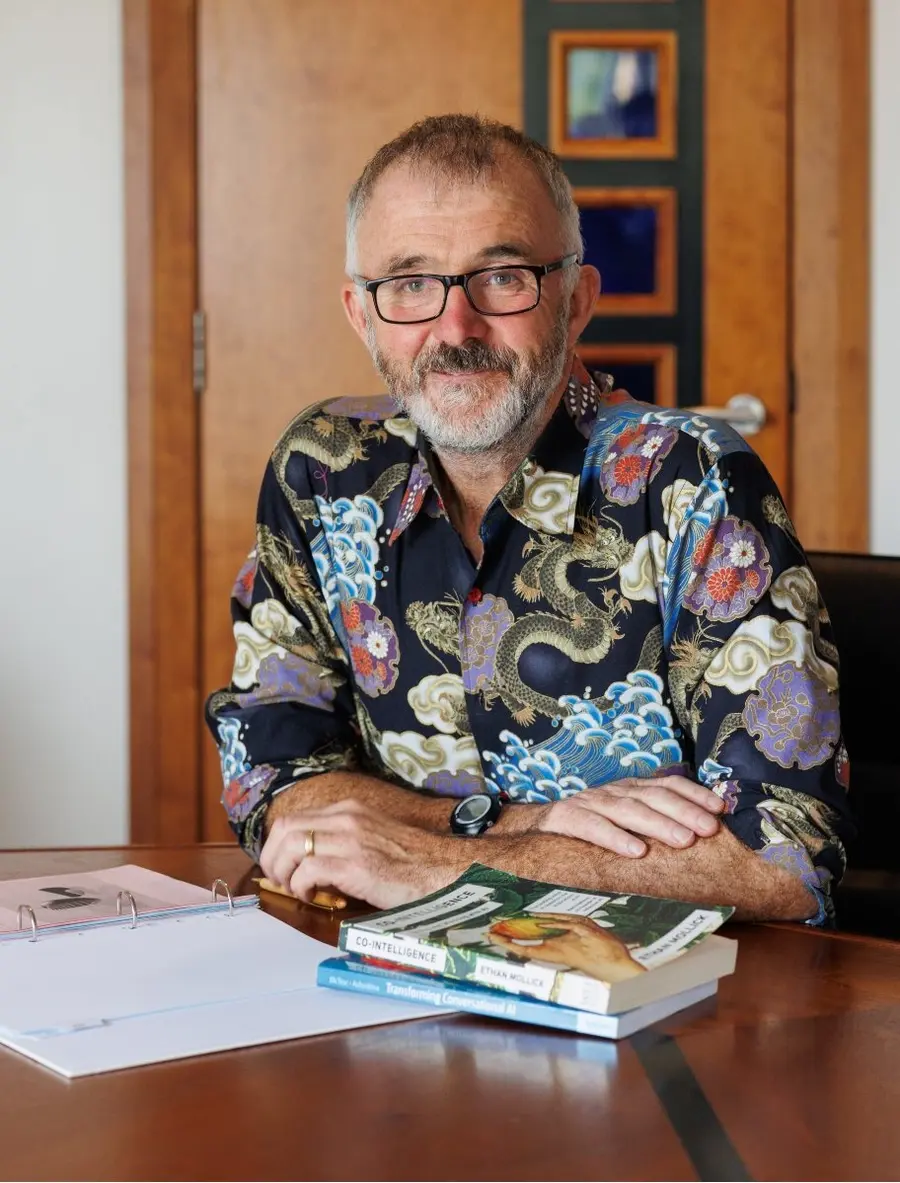


Barry Phillips (CEO) BEM founded Legal Island in 1998. He is a qualified barrister, trainer, coach, and meditator, and a regular speaker here in the UK and Ireland, and abroad.
Barry has completed the Oxford University course “Leading AI Implementation” in June 2026. He has trained hundreds of HR Professionals on how to use GenAI in the workplace and is the author of the book “ChatGPT in HR – A Practical Guide for Employers and HR Professionals”




This week Barry Phillips argues that a lot of bias in AI is more to do with human prompting than biased data or algorithms.
Transcript:
Hello Humans!
And welcome to the weekly podcast that aims to cover an important AI for HR issue in around 5 minutes. My name is Barry Phillips.
Let's start with a strange fact.
Or, more accurately, a strange recurring experiment.
Ask ChatGPT to choose a random number between one and one hundred and it may be much more likely to choose 42 than a genuinely random system would.
Why 42?
Fans of The Hitchhiker’s Guide to the Galaxy will know it as the answer to life, the universe and everything. The number appears all over online culture. ChatGPT has absorbed those patterns and, when asked for a number, predicts an answer that looks plausible.
We cannot prove that 42 appears because science-fiction fans spent too long in chat rooms. That is a cracking story, but it is still a story. What the example does show is that an AI’s answer can reflect patterns and associations in its training, even when we expect randomness.
Bias in training data is hardly breaking news. Studies of popular language models have found evidence of Western cultural bias in their outputs. Wikipedia has reported a striking imbalance too: Wikimedia says around 87 per cent of its contributors are male.
And this matters directly to HR. Researchers testing language models in simulated recruitment have found that names associated with race or gender can affect hiring decisions and salary recommendations.
A model can inherit yesterday’s assumptions and present them in tomorrow’s font.
But before we blame a secret training process taking place in a mysterious bunker somewhere in California, there is another possible source of bias much closer to home.
Us.
Consider these three prompts. Which one do you think is best designed to reduce bias?
Prompt A:
“Explain how camera monitoring improves the productivity of remote employees.”
Prompt B:
“To what extent is camera monitoring an effective way to manage the productivity of remote employees?”
Prompt C:
“Assess the use of camera monitoring for remote employees. Consider the quality of the available evidence, potential benefits and harms, employee and employer perspectives, legal and ethical considerations, and alternative ways of achieving the same objectives. Identify any assumptions or information needed before reaching a conclusion.”
Prompt A has already reached its verdict. Camera monitoring improves productivity.
It is a leading question.
Prompt B is better. It permits challenge, but still assumes that cameras and productivity are connected. It also quietly treats productivity as the problem and monitoring as the proposed cure.
Prompt C is the strongest. It tests the premise, asks for evidence, includes different perspectives, considers alternatives and makes room for uncertainty.
It also recognises something HR should know already: being visible at a desk is not the same as being productive.
If it were, every office pot plant would be employee of the month.
If bias genuinely matters, ask an LLM to audit your prompt before you use it. You might ask Claude to identify loaded language, hidden assumptions and missing perspectives, then take the revised prompt to ChatGPT, or do it the other way round.
But do not mistake two chatbots agreeing for independent verification. They may have read many of the same books, websites and opinions.
So the lesson this week is simple.
When an AI gives us a biased answer, the bias may come from its training data, its design or the context we supplied. But sometimes it comes from the question we asked and the conclusion we smuggled into it.
Before asking whether the machine is biased, inspect the prompt. Challenge its assumptions. Ask what evidence is missing. Invite competing explanations.
Because artificial intelligence can amplify human bias at extraordinary speed.
And the most dangerous bias may not be hidden inside the machine.
It may be sitting at the keyboard.
Until next week. Bye for now!

 Get the Most from Copilot (Level 1): A Practical Guide for HR