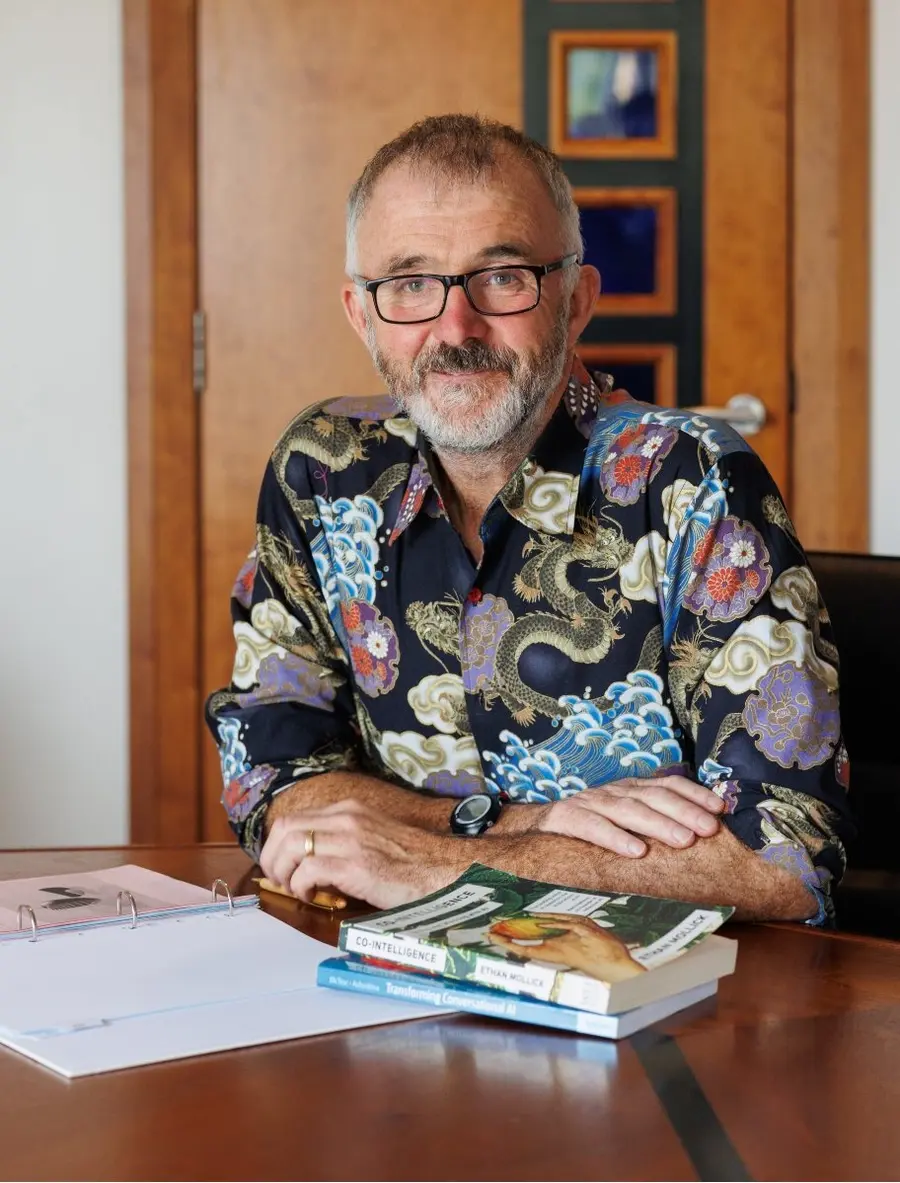


Barry Phillips (CEO) BEM founded Legal Island in 1998. He is a qualified barrister, trainer, coach, and meditator, and a regular speaker here in the UK and Ireland, and abroad.
Barry has completed the Oxford University course “Leading AI Implementation” in June 2026. He has trained hundreds of HR Professionals on how to use GenAI in the workplace and is the author of the book “ChatGPT in HR – A Practical Guide for Employers and HR Professionals”



This week Barry Phillips asks: what happens when your colleagues start confiding in machines?
Transcript:
Hello Humans
Welcome to the podcast that aims to summarise an important AI development each week relevant to the world of HR. My name is Barry Phillips
Today I want to talk about something that's been quietly happening in your organisation. And it's not in any policy yet. It's probably not in your wellbeing strategy. But it's already underway.
People are talking to AI instead of each other.
Now, I don't mean just asking ChatGPT to fix a formula in Excel. I mean the deeper stuff. The human stuff.
Employees are using AI tools -whether that's Claude, ChatGPT, Copilot, whatever they've got open on a second tab to ask questions they used to bring to a colleague. Things like: "How do I handle a difficult conversation with my manager?" Or "Do you think I'm ready for a promotion?" Or even, "I'm really struggling today. Can we just talk through it?"
That last one might make you pause. It made me pause too.
But think about it from the employee's perspective. AI is available at half nine on a Tuesday morning when your manager is in back-to-back meetings. It doesn't judge. It doesn't gossip. It doesn't have its own agenda. And it gives a thoughtful response in about three seconds.
For a lot of people, that's a genuinely useful outlet.
So what does this mean for those of us working in HR across the island of Ireland?
A few things.
First - this is already happening, whether you've acknowledged it or not. There's no point waiting to see if it becomes a trend. It is the trend. The question is whether your organisation responds proactively or reactively.
Second -there's a trust gap here worth examining. If your people are turning to AI for career guidance rather than a line manager or an L&D team, that's telling you something. Not necessarily something catastrophic, but something worth listening to. Why aren't those conversations happening internally? Is it fear of judgement? A lack of time? A culture where showing vulnerability feels risky?
Third -and this is important -AI isn't a replacement for human connection, but it can be a bridge to it. Used well, it can help someone prepare for a difficult conversation before they have it. It can help a person articulate what they actually need before they knock on HR's door. In that sense, it's not your competition. It could actually help you.
Of course, it's not without risk. AI doesn't know your organisation. It doesn't know the redundancy consultation that's quietly underway, or the manager whose team is quietly falling apart. It can give genuinely good-sounding advice that is entirely wrong for a specific context.
There's also a data consideration. Employees may be sharing sensitive personal information - about their mental health, their performance anxieties, their relationships at work - into consumer tools without thinking about where that data goes. That's a conversation HR and IT need to be having together, if you're not already.
And finally, if AI becomes the primary source of emotional support for your workforce, that is not a wellbeing strategy. That is a warning sign.
So here's my challenge to the HR community: don't let AI become the coworker your people never had the courage to be for each other. The fact that someone is turning to a machine for honest feedback, for career support, for a kind word on a hard day - that's not a technology story. That's a culture story. And culture? That's still very much your department.
Bye for now!

 AI Literacy Skills at Work: Safe, Ethical and Effective Use